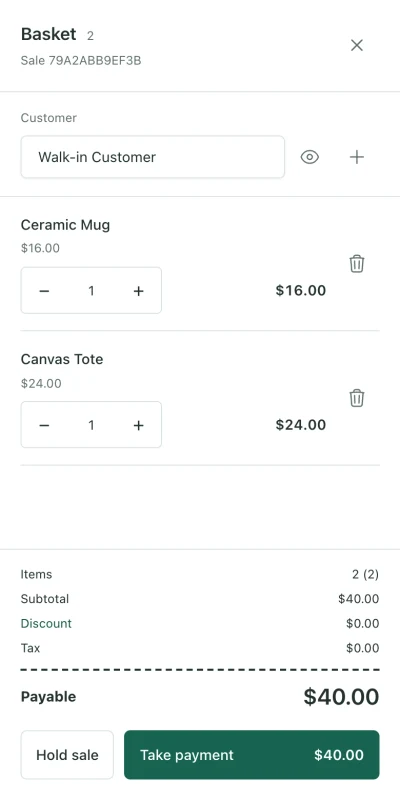
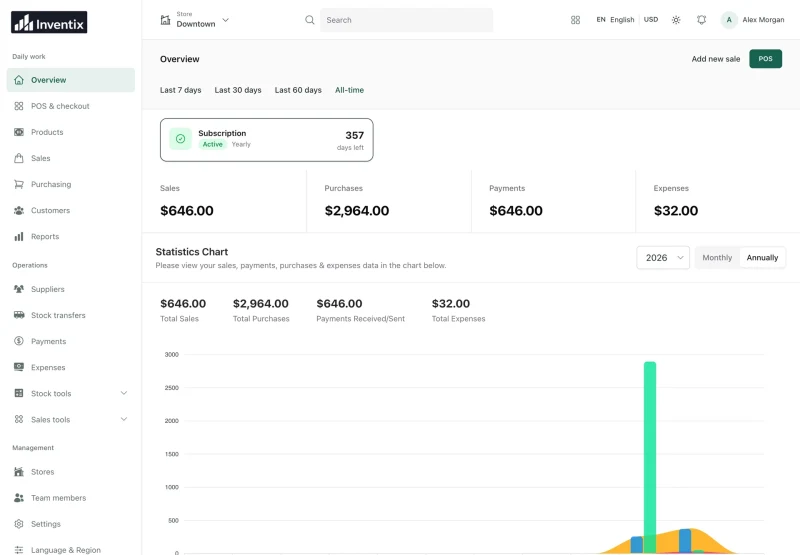
Inventix desktop overview and mobile checkout, shown with demo data.
On this page01/05Product context
The product context
I created Inventix as a multi-location inventory and POS SaaS. My work covers the product model, application architecture, tenant runtime, management system, and deployment responsibilities.
Inventory software connects operational decisions to data that must stay consistent. A SaaS product adds another boundary: each business needs an isolated, correctly resolved working context.
Tenant request lifecycleOne business context, from entry to cleanup.
01Resolve
Identify the business through the platform schema
HTTP request or queued job
02Scope
Set the runtime connection to its tenant schema
Isolated PostgreSQL context
03Reset
Purge the connection after execution
Ready for the next operation
Simplified architecture, based on the tenant-runtime implementation and its documented invariants.
Contributions & impact
01
Multi-location inventory & POS
Inventory, sales, purchasing, and point-of-sale workflows in one SaaS product.
Why it matters
Connects everyday business operations across locations.
Responsibility
Product conception, architecture, and full-stack development.
Inside the engineering
Connected inventory, sales, and purchasing workflows.
Application behavior designed around location and tenant context.
02
Tenant & platform architecture
A tenant runtime with separated platform-management responsibilities.
Why it matters
Gives each business an isolated working context within the SaaS platform.
Responsibility
Software architecture and backend development.
Inside the engineering
PostgreSQL schemas separate tenant data.
HTTP requests and queued jobs resolve the business through the platform schema, then scope the runtime connection to its tenant schema.
The connection is purged after execution so the next operation starts without a previous tenant’s context.
The runtime role cannot create schemas; provisioning and upgrades use a separate database role.
The management application owns the platform lifecycle.
03
Deployment & ongoing operation
Provisioning, schema upgrades, workers, and deployment checks as part of the product.
Why it matters
Connects application changes to the operational responsibilities of running a SaaS.
Responsibility
Platform engineering, deployment, and continuing product development.
Inside the engineering
Tenant schema upgrades are versioned and support a single-tenant canary before a batch rollout.
Provisioning, scheduled work, queues, and tenant verification are explicit release responsibilities.
Architecture & product capabilities
Architecture decisions
Tenant boundaries
The application uses PostgreSQL schemas to separate tenant data, with context initialized and reset around requests and background jobs.
Separated responsibilities
The management application owns the platform lifecycle while the inventory application serves tenant workflows.
Operational delivery
Provisioning, schema upgrades, workers, and deployment checks are part of the software architecture.
Product capabilities
Multi-location inventory
Point of sale
Sales and purchasing
Tenant and platform management
NextWork with me
Let’s build your next product.
Bring the problem. We’ll work through the product, architecture, and delivery. Consultation and mentorship start with a free call.