
Zaman TauhidTechnical Lead & Software Architect
Zaman Tauhid

ResumeGitHubLinkedIn

Technical Lead & Software Architect · Dhaka, Bangladesh

wcbrain

A smarter shopping journey for WooCommerce.

An AI commerce platform for WooCommerce: personalized storefronts, semantic search, adaptive filters, recommendations, and a shopping assistant grounded in the store’s catalog.
Product demonstration

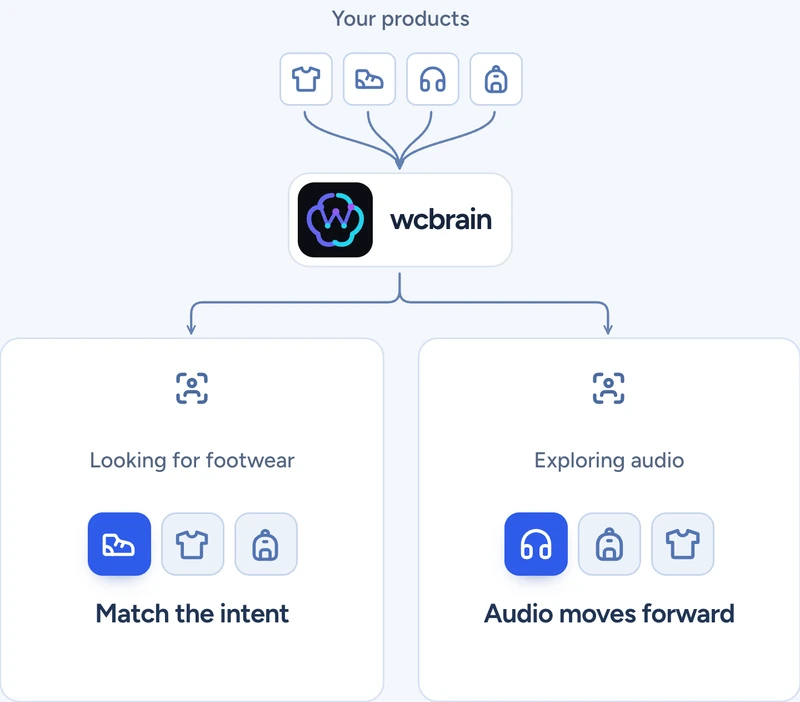
One store. Different for every shopper.

wcbrain discovery illustration: product categories flow through wcbrain to two shoppers, one looking for footwear and another exploring audio
  • Intent-aware search
  • Personalized discovery
  • Shopping assistance

Product discovery demonstration from wcbrain’s current site. Explore the story for merchant dashboard captures and engineering details.

The product context

I conceived, architected, and developed wcbrain to connect the whole shopping journey: discovering products, narrowing the choice, asking questions, and taking a supported action. I own the product across its WooCommerce integration, hosted AI services, customer platform, deployment, and continuing development.

A useful shopping system needs more than a chat window. Search must understand intent, recommendations must fit the context, and assistance must stay grounded in product facts. I designed wcbrain around that connection, with merchant controls in WordPress and WooCommerce retaining authority over prices, availability, cart validation, and checkout.

Merchant control, built into WooCommerce.

The shopping experience is one part of the product. The other is giving store owners clear controls over discovery, approved knowledge, and supported actions.

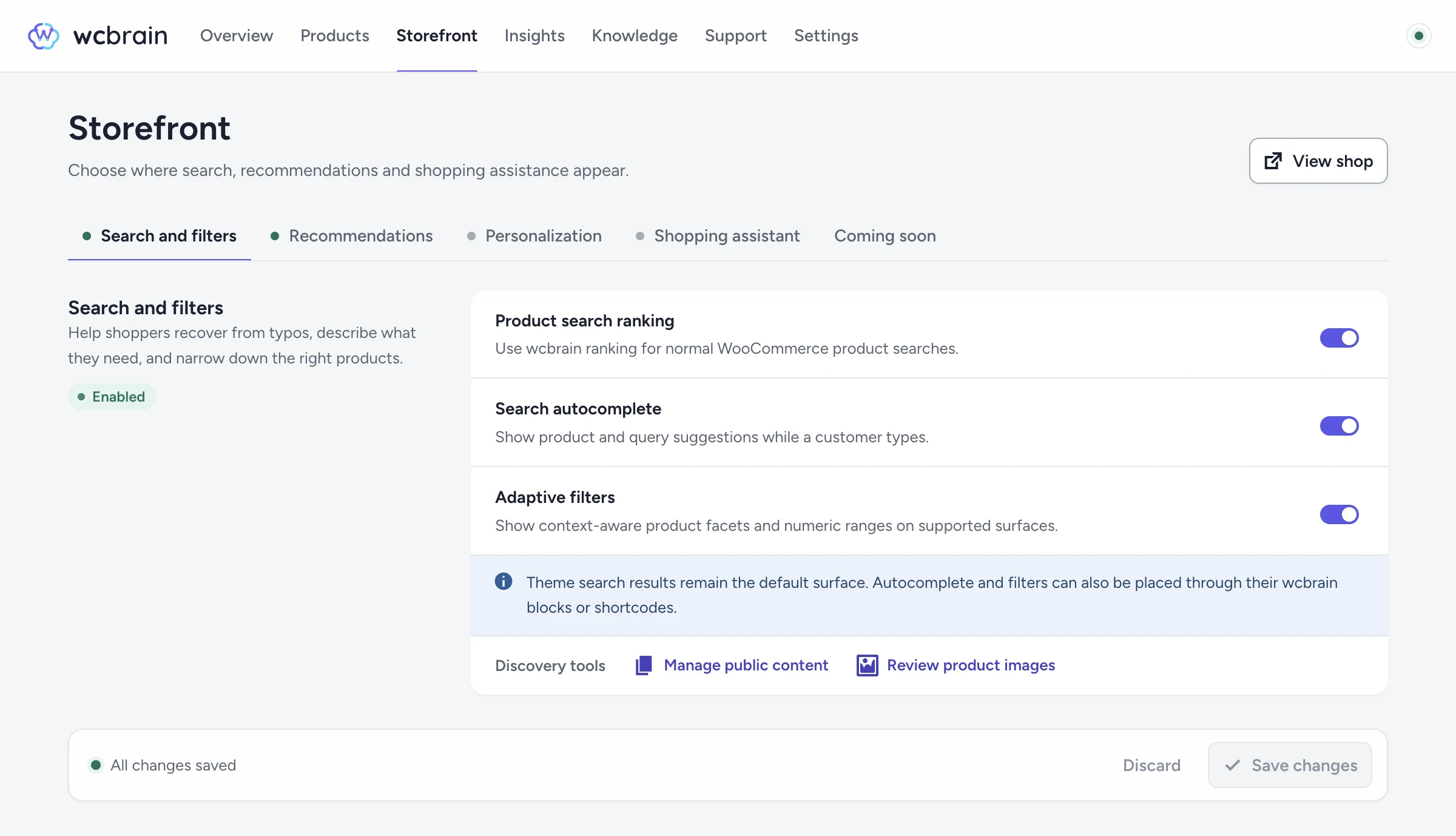
Search & discovery controls

Merchants turn on search ranking, autocomplete, and adaptive filters from one place. Theme search stays the default surface, and blocks or shortcodes place discovery where the store needs it.

wcbrain Storefront settings, Search and filters tab: product search ranking, search autocomplete, and adaptive filters enabled, with links to manage public content and review product imagesView full-size capture (opens in a new tab)

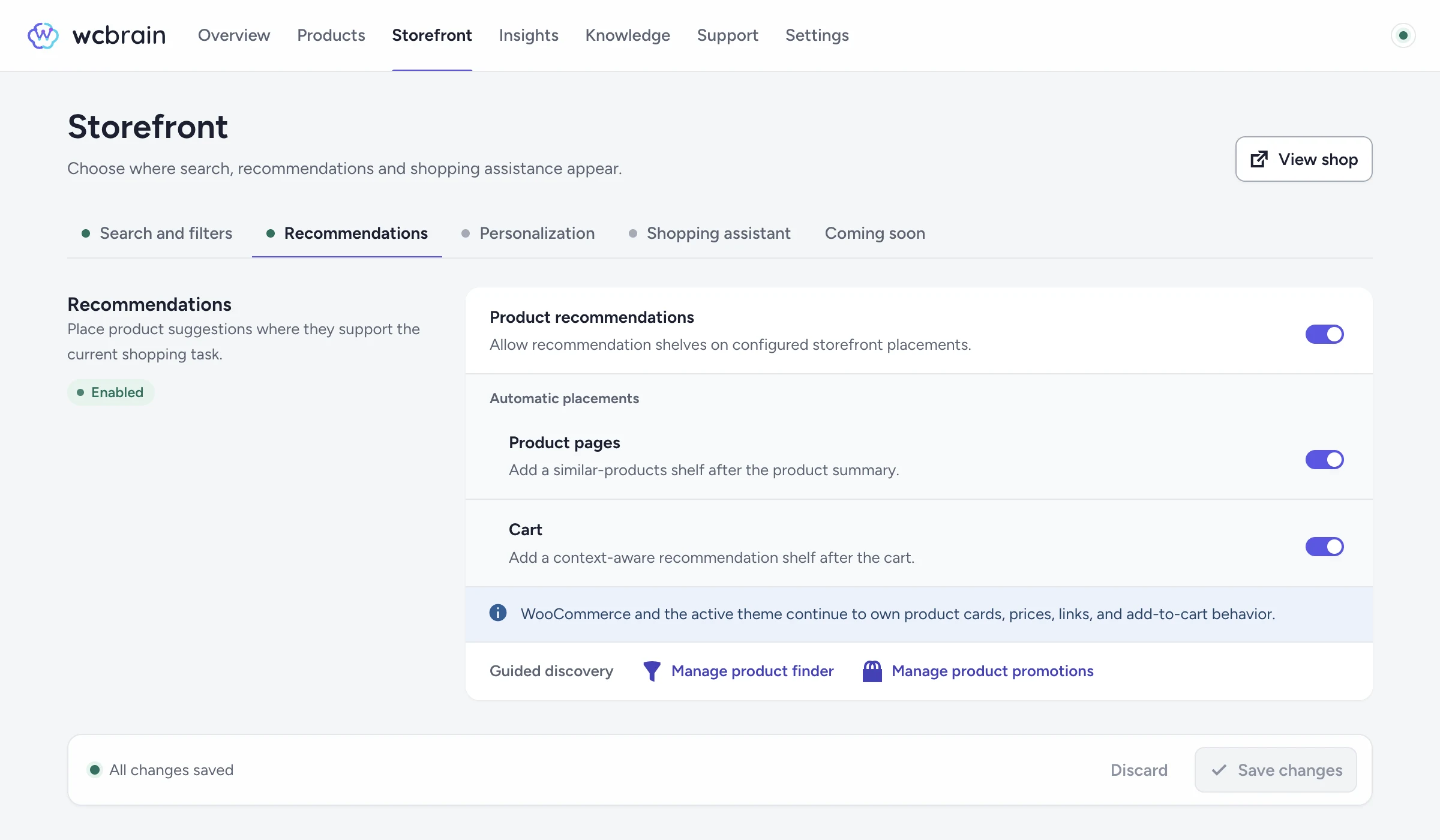
Recommendations & guided discovery

Recommendation shelves are placed on product pages and in the cart. WooCommerce and the active theme keep ownership of product cards, prices, links, and add-to-cart behavior.

wcbrain Storefront settings, Recommendations tab: product recommendations enabled with automatic placements on product pages and the cart, plus links to the product finder and product promotionsView full-size capture (opens in a new tab)

Captures from the wcbrain merchant dashboard inside WordPress. The opening visual is a discovery demonstration.

Contributions & impact

Search & personalized discovery

Semantic and hybrid search, adaptive filters, personalized listings, and contextual recommendations in WooCommerce.

Why it matters
Gives shoppers several ways to find a relevant product: describe the need, narrow the results, or explore suggestions that fit the context.
Responsibility
Product conception, AI integration, and application development.
Inside the engineering
  • Connected the WooCommerce catalog to hosted discovery services for semantic retrieval, autocomplete, typo tolerance, and reviewed synonyms.
  • Integrated result-aware filters with categories, prices, attributes, and numeric ranges.
  • Built personalization into shop and category listings, with recommendation placements for alternatives, complementary products, and frequently bought-together items.

Catalog-grounded shopping assistance

An AI assistant that asks focused questions, compares product details, and guides supported product and cart actions.

Why it matters
Connects buying questions to the store’s product facts and a concrete next step, with commerce validation retained by WooCommerce.
Responsibility
Assistant architecture, AI integration, and action workflows.
Inside the engineering
  • Grounded answers in the synchronized catalog and explicitly approved store knowledge.
  • Connected conversation continuity and exact supported variation choices to the storefront journey.
  • Required confirmation for supported cart changes and revalidated those changes inside WooCommerce.

Merchant controls & discovery insights

WordPress controls for discovery, guided product finders, merchandising, and insight into search activity and catalog gaps.

Why it matters
Lets store owners shape the shopping experience and investigate where discovery needs attention.
Responsibility
Product design, merchant workflows, and full-stack implementation.
Inside the engineering
  • Kept search, assistant, personalization, and recommendation settings within WordPress.
  • Built merchant-authored branching finders, product pinning, scheduled campaigns, and draft previews.
  • Connected discovery activity, zero-result gaps, and catalog coverage to merchant-facing insights.
  • Made image-derived attribute suggestions reviewable, with explicit approval and rollback.

Store integration & synchronization

A WooCommerce plugin connecting the store to hosted discovery services.

Why it matters
Adds AI capabilities while preserving the store’s authority over products, current prices, availability, cart, and checkout.
Responsibility
Integration architecture and backend development.
Inside the engineering
  • Separated catalog synchronization and storefront integration from hosted search and intelligence responsibilities.
  • Used native WooCommerce validation for supported offer and cart behavior.
  • Kept scoped catalog-discovery connections short-lived and read-only, separate from cart and order operations.

Commercial platform architecture

Accounts, billing, licensing, and entitlements separated from the AI data plane.

Why it matters
Gives the commercial product clear responsibilities across its services.
Responsibility
Software architecture, implementation, and operational delivery.
Inside the engineering
  • Independent account and commercial services.
  • Separation of commerce integration, hosted intelligence, and customer management.
Architecture & product capabilities

Architecture decisions

Store-native commerce, hosted intelligence

The WooCommerce plugin connects the catalog and storefront to hosted discovery services. Native commerce validates current offers and supported cart actions.

Grounded assistance and explicit actions

Product facts and approved store knowledge inform the assistant. Supported cart changes require confirmation and are revalidated inside WooCommerce.

Merchant control over automation

Search behavior, recommendations, guided-finder questions, and merchandising remain configurable. Attribute suggestions require review; campaign changes can be previewed before publication.

Separate commercial responsibilities

Accounts, billing, licensing, and entitlements stay separate from the search and AI data plane, with deployment and ongoing operation treated as part of the product.

Product capabilities

  • Semantic and hybrid search, autocomplete, typo tolerance, and reviewed synonyms
  • Personalized shop and category listings with context-aware recommendations
  • Adaptive filters with combined attributes, numeric ranges, and shareable constraints
  • Catalog-grounded conversations, product comparison, and confirmed native cart actions
  • Merchant-authored guided product finders and approved public-content discovery
  • Browser-assisted voice input and service-enabled visual product search
  • Product pinning, scheduled merchandising, preview controls, and discovery insights
  • Reviewable image-derived attribute suggestions with approval and rollback
  • Scoped, short-lived, read-only catalog discovery connections

NextWork with me

Let’s build your next product.

Bring the problem. We’ll work through the product, architecture, and delivery. Consultation and mentorship start with a free call.